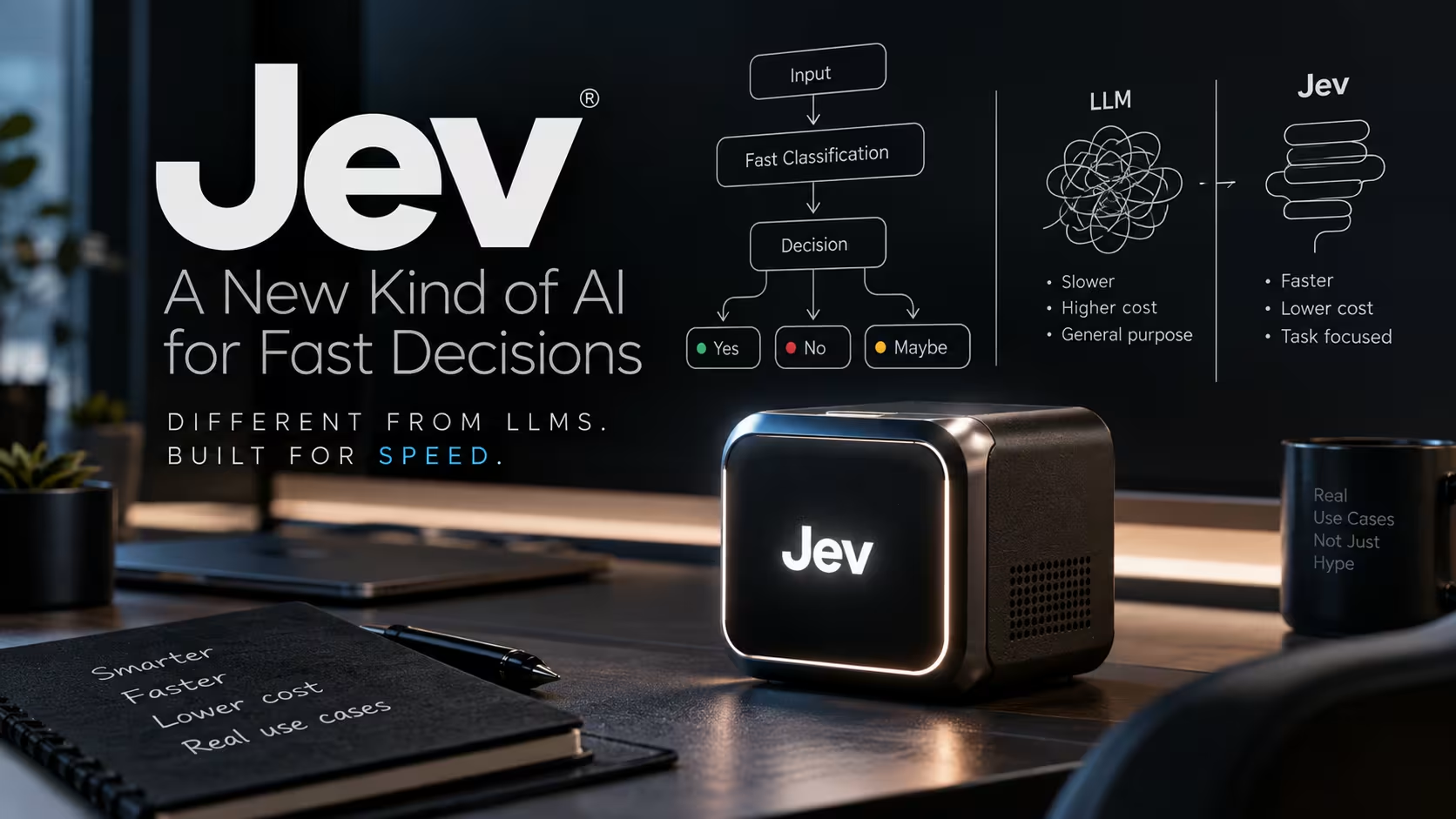
Every week there seems to be another AI model, another benchmark and another claim that something is going to change everything. Most of it is worth watching for a while before getting excited about it. Jev caught my attention for a different reason. It is not trying to be a better chatbot. It is trying to solve a much narrower problem that software deals with constantly: making small decisions quickly, cheaply and in a format that code can actually use.
First, Jev is not another ChatGPT
That is probably the easiest way to understand why people are paying attention to it.
Large language models such as GPT and Claude are designed to work with language. You give them a prompt and they generate an answer token by token. That makes them incredibly flexible. They can write, explain, reason, summarize and hold a conversation.
But sometimes software does not need an essay.
Sometimes it just needs an answer to a small question.
Which department should receive this customer message?
Is this enquiry urgent?
Is this likely spam?
Which tool should an AI agent use next?
Which category does this product belong to?
For those kinds of jobs, asking a large reasoning model to think through the problem and generate a response can be unnecessary. Jev is presented as a decision model. Give it some context, a question and a set of possible answers, and it assigns probabilities to those choices.
Think of it less like asking an AI to write something and more like asking it to make a quick judgement.
A simple example makes this easier
Imagine a customer sends this message:
My package arrived damaged and I want a refund.
Your support system needs to decide where the message should go.
You could give Jev four options:
- Billing
- Shipping
- Technical support
- General support
The model looks at the message and returns probabilities for those options. Your software can then use the highest probability to route the request.
The interesting part is that this is supposed to work without building and training a separate classifier for every individual business problem.
That is where the idea becomes useful. Natural-language classification starts behaving more like a normal software primitive.
Why use a decision model when an LLM can already do this?
This was my first question too.
If you give GPT or Claude the same message, tell it the available categories and ask for structured JSON, it can normally classify the message just fine.
So Jev is not interesting because it invented classification.
It is interesting because it is trying to make this kind of classification much faster and cheaper.
In the session that introduced the model, one live test compared the same classification task using GPT-5 and Jev. GPT-5 completed one run in roughly 6.58 seconds while Jev returned its answer in about 472 milliseconds. Another run was roughly 4.19 seconds versus 781 milliseconds.
Those are useful demonstrations, but they should not be mistaken for a universal benchmark. Latency changes with infrastructure, network conditions, models and workload.
The bigger point is architectural: if the job only requires choosing between known outcomes, generating a long sequence of tokens may be unnecessary work.
The cost argument may be even more important than speed
A few seconds of latency is annoying. Cost becomes a much bigger issue when the same decision needs to happen thousands or millions of times.
Imagine software classifying 10,000 support messages every day.
Using a large model for every tiny routing decision means paying for the input tokens and usually some output tokens every single time.
A specialised decision model has a different economic goal: process that state, choose from a limited set of possibilities and return the answer without generating unnecessary language.
This matters when AI stops being something users occasionally click and starts running quietly inside ordinary software.
The important question changes from “Can AI do this?” to “Can we afford to let AI do this every time?”
One context, several decisions
Another interesting part of Jev is the way multiple questions can be evaluated against the same piece of information.
Take that damaged-package message again.
Instead of asking only where the email should go, a system might also want to know:
- Which department should receive it?
- Is the request urgent?
- Is the customer requesting a refund?
- Does the message sound angry or neutral?
- What language is being used?
The model is designed to evaluate several of those questions together rather than turning each one into a separate long conversation.
That starts to make sense for real business automation, where a single customer message may trigger several decisions before anything happens.
The confidence score is more useful than it sounds
Jev also returns a confidence value with its decisions.
That gives developers something practical to work with.
For example:
Above 90% confidence: automatically perform the action.
60% to 90%: ask for more information or use another model.
Below 60%: send it to a human.
This is much more useful than pretending an AI system must either be fully autonomous or completely manual.
A sensible automation system should know when it is unsure.
Good automation is often not about removing humans. It is about deciding when a human is actually needed.
Why constrained answers matter
Another difference is that Jev works from the answer choices you provide.
If the valid answers are Billing, Shipping, Technical and General, the software does not need a beautifully written paragraph explaining its feelings about the problem.
It needs one of those four outcomes.
This avoids an annoying problem developers regularly deal with when connecting language models to software: the model returns something that is understandable to a person but inconvenient for a program.
Maybe you asked for refund and received returns and refunds. Maybe the model adds commentary around the JSON. Maybe it says two categories are possible.
There are already good ways to constrain modern LLM outputs, so this is not a problem unique to Jev. The interesting part is that constrained decision output is the core job of the model rather than an extra instruction wrapped around a general-purpose language model.
The “System 1 vs System 2” idea is probably the easiest mental model
The session uses the idea of fast and slow thinking to explain where a model like Jev fits.
Some problems require deliberate reasoning.
Planning a complicated project, debugging difficult code, analysing evidence or deciding how to solve a new problem may require a powerful language model that can reason through several steps.
Other decisions are much smaller.
Which queue should this message enter?
Which tool should the agent call?
Does this content match one of these categories?
Should this request go through automatically or be reviewed?
Those are closer to fast decisions.
The useful idea is not that one type of model replaces the other.
A larger reasoning model can decide the plan. A smaller decision model can handle many of the routine choices inside that plan.
Where could this actually be useful?
This is where the topic becomes much more interesting than another model benchmark.
1. AI agent routing
An AI agent may have ten available tools. It still needs to decide which one should handle the current task.
A large model may still handle planning and difficult reasoning, while a faster classifier handles straightforward routing decisions.
2. Customer support triage
A support message can be classified by department, urgency, intent, sentiment and other properties before anyone reads it.
The obvious benefit is not replacing support staff. It is getting the right request to the right place sooner.
3. Spam, moderation and safety checks
Fast classification can sit in front of more expensive systems and decide whether something looks unsafe, irrelevant or suspicious before another model processes it.
4. Search and retrieval routing
A system might decide whether a question should use internal documents, a database, a web search or the model’s existing knowledge.
That decision is relatively small compared with generating the final answer.
5. Product and content categorisation
Reviews, products, tickets, transcripts and other messy text can be classified into useful attributes without building a separate traditional machine-learning pipeline for every category.
6. Real-time interfaces
If decisions are fast enough, software can adapt while the user is interacting with it instead of waiting several seconds for a large model to reason through every action.
A useful example: turning reviews into structured product information
One demo in the session takes a set of smartphone reviews and tries to extract ratings for things such as the camera, battery, display, design, performance, build quality and value for money.
For every review, the system effectively asks two questions for each attribute: is this attribute being discussed, and if it is, how positive or negative is the customer’s opinion?
Those results can then be aggregated into something useful for a product page.
This is exactly the kind of task that would traditionally involve a dedicated NLP model, fine-tuning, rules or a more expensive general-purpose LLM pipeline.
Whether Jev becomes the winning implementation is less important than the idea itself: generalised classification may become a service developers call whenever software needs a quick judgement about messy human language.
This does not mean LLMs are going away
I think this is where some of the discussion around decision models gets unnecessarily dramatic.
Jev is not a replacement for a model that needs to write, reason, explain or create something.
If I want an AI to understand a complicated business problem, design a solution, write an article, debug a codebase or hold a useful conversation with a customer, a capable language model still makes far more sense.
The interesting possibility is that we stop using the same expensive model for every part of an application.
We already do this everywhere else in software engineering. We choose different databases, queues, caches and services for different jobs.
AI infrastructure may start looking the same way.
Use the expensive intelligence where intelligence is required. Use the fast decision engine where the software only needs a decision.
There are also some important limitations
This is a new area, and it would be a mistake to turn an interesting model into another round of AI mythology.
The benchmark story is still developing
Some of the headline speed and cost claims are vendor claims or early demonstrations. Independent benchmarks matter, especially once developers start comparing different decision models under the same conditions.
It is not designed for deep reasoning
Speed comes with a trade-off. A model built to make quick decisions is not where you send a problem that requires ten minutes of careful reasoning.
It is text-focused
The version discussed in the session works primarily with textual state. Images, video and audio require a different setup or another model in front of it.
Explainability is limited
A decision and confidence score can be useful for routing. They may not be enough in situations where a business must explain exactly why a decision was made.
A lot about the architecture is still a black box
The session spends a substantial amount of time trying to infer how Jev may work internally, but this part should be treated as informed speculation rather than established architecture.
That distinction matters.
Interesting technology does not become more credible when we pretend unknown details are already known.
What I think this means for business automation
This is the part I find most relevant.
Businesses probably do not care whether something is technically called an LLM, a classifier or a System 1 decision model.
They care about the result.
Can an enquiry reach the right person faster?
Can an assistant recognise what service a customer needs?
Can obvious spam be filtered before somebody wastes time reading it?
Can a booking request be checked against simple business rules?
Can software decide when it has enough confidence to continue and when it should ask a human?
That is where cheaper and faster decision making could become valuable.
It also changes how I think about AI assistants for small businesses.
The visible chatbot is only the part the customer sees. Behind it, there may eventually be several different systems deciding intent, routing requests, checking rules, choosing tools and deciding when a human should take over.
The best AI system may not be one giant model doing everything. It may be several specialised pieces working together.
Could decision models become part of normal software?
That may be the bigger story here.
Right now companies still talk about “adding AI” as if it is a separate feature.
There is an AI button. An AI chatbot. An AI page. An AI assistant.
If models become cheap and fast enough to make small decisions constantly, AI becomes less visible.
It simply becomes part of the logic underneath the application.
Instead of:
Click here to use our AI feature.
the software quietly asks hundreds of tiny questions while you use it.
Which result is relevant?
Which workflow should start?
Is this request unusual?
Should we ask another question?
Does a human need to see this?
That is a much more interesting future than putting another chatbot in the bottom-right corner of every website.
My takeaway
I would not look at Jev as “the model that replaces LLMs.” I think that misses the point.
The useful idea is much simpler.
We have been using very capable language models for many jobs that do not require all of that capability.
If specialised decision models can make those smaller decisions reliably, quickly and cheaply, software engineers get another useful building block.
The large model can think.
The decision model can route.
Normal software can enforce the hard rules.
Humans can still take over when the system is uncertain.
That combination is much closer to how I expect serious AI automation to be built than the idea of giving one chatbot complete control of everything.
Jev itself is still early. Some of the performance claims need more independent testing, the architecture is not fully disclosed, and competing approaches are already appearing.
But the idea behind it is worth paying attention to.
AI does not always need to talk. Sometimes it just needs to make the right small decision and get out of the way.
Frequently asked questions
What is Jev AI?
Jev is presented as an AI decision model designed to classify information and choose between predefined options quickly rather than generate long-form text like a traditional large language model.
Is Jev an LLM?
It is positioned differently from a normal autoregressive LLM. The focus is fast structured decision making rather than generating an open-ended textual response token by token.
Will Jev replace ChatGPT, Claude or other LLMs?
Probably not. The more interesting use is combining different model types. Large language models can handle reasoning, planning and generation while decision models handle smaller routing and classification tasks.
What can decision models be used for?
Possible applications include support-ticket routing, lead classification, spam detection, moderation, agent tool selection, retrieval routing, product categorisation and other situations where software needs to choose between known outcomes.
Why not simply use a small LLM?
You can, and in many projects that may still be the right choice. The argument for specialised decision models is that they may provide lower latency, lower cost and outputs designed specifically for programmatic decisions at large scale.
Is Jev already proven in production?
It is still early. The demonstrations are interesting, but benchmark quality, independent validation, reliability across different workloads and competition from other models will become clearer with time.
AI is useful when it removes work, not when it adds another tool to manage.
If you run a local business and are thinking about AI for enquiries, bookings, customer questions or repetitive work, I can look at how you currently handle it and tell you where automation may actually make sense.
Tell me what you want to automate →